Google's Gemini 3.1 Flash Live lands in Google AI Studio — 90-language real-time voice that hears background noise, tracks tone, and calls external tools mid-conversation. The race for agent infrastructure just got a clear frontrunner.
What would it take for an AI to hold a real conversation — not the stilted, robotic kind where you wait two seconds between each exchange, but something that actually mirrors how humans talk? That question has driven billions in compute spend and reshaped the strategic priorities of every major AI lab. On March 26th, 2026, Google DeepMind answered it with Gemini 3.1 Flash Live — and the architecture under the hood reveals just how seriously the AI voice race has become.
The announcement came quietly through Google AI Studio, but what it enables is anything but quiet. Developers can now access Gemini 3.1 Flash Live through the Gemini Live API and build agents that see, hear, and respond in real time — with latency low enough to sustain genuine back-and-forth dialogue. The benchmark numbers back up the launch language. On ComplexFuncBench Audio, a test designed specifically for multi-step function calling under real-world constraints, Gemini 3.1 Flash Live scores 90.8 percent. On Scale AI's Audio MultiChallenge — which throws interruptions, hesitations, and complex instruction sequences at models — it leads with 36.1 percent when thinking mode is enabled. These are not incremental numbers. They represent a step change in what on-device and cloud-hosted voice agents can actually do.
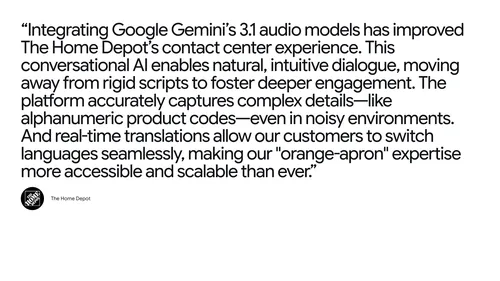
To understand why this matters, you need to understand where the previous generation of voice LLMs fell apart. The core problem was not raw capability — it was reliability under noise. A voice agent deployed in a call center or customer-facing application does not get the clean audio of a studio recording. It gets traffic noise, background chatter, television audio, bad microphone input. The previous generation of models, including Gemini 2.5 Flash Native Audio, handled this poorly. They would mis-trigger on ambient sound, drop function calls mid-conversation, or produce choppy output when the acoustic environment got messy. Gemini 3.1 Flash Live has been explicitly engineered to solve this. According to Google's own release notes, the model has significantly improved its ability to distinguish relevant speech from environmental noise, which translates directly to more reliable tool calls during live conversations.
The tool-calling improvement is where enterprise AI teams should pay close attention. Large-scale inference workloads running through voice interfaces typically require external API calls — fetching customer records, querying databases, triggering workflows. If the model drops that call because it misheard a word or got confused by background noise, the downstream failure cascades into a broken user experience. Google's claim with 3.1 Flash Live is that this reliability gap has been substantially closed. Verizon and The Home Depot are among the early enterprise adopters cited in the release — two companies with enormous call volume and very low tolerance for AI hallucinations or missed function calls.
The model's multilingual architecture is equally significant. Support for over 90 languages in real-time multimodal conversation is not a checkbox feature — it is a prerequisite for global deployment. OpenAI's voice infrastructure has historically been English-centric in its strongest capabilities. Anthropic's Claude, despite its reasoning strength, does not yet offer native real-time voice interaction. Google DeepMind, by shipping Gemini 3.1 Flash Live as the backbone of both Google Search Live and the consumer Gemini Live app in over 200 countries, is making a deliberate play to own the voice layer of AI globally — not just in North America.
Sundar Pichai's DeepMind team under Demis Hassabis has been building toward this architecture for years. The Gemini models — moving from 1.0 through 2.5 and now into the 3.x generation — have been explicitly multi-modal from the ground up, unlike the GPT lineage, which started as text-in-text-out and bolted on voice and vision as capabilities. That architectural choice is now paying off. A model that was trained to process audio, video, and text simultaneously from the start handles the fine-tuning required for real-time voice with far less degradation than models that were retrofitted. The weights of Gemini 3.1 Flash Live carry that native multimodal training in ways that are difficult for competitors to replicate quickly.

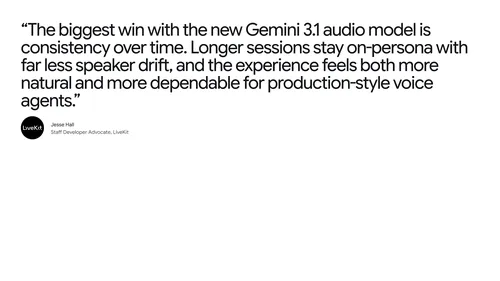
For developers, the practical question is build versus wait. The Gemini Live API is live in Google AI Studio now. The documentation covers WebRTC scaling, global edge routing through third-party partners, and the GenAI SDK integration path. Companies like LiveKit — which provides the WebRTC infrastructure layer for many production voice applications — have already integrated. The barrier to shipping a real-time voice agent that handles complex tasks is now significantly lower than it was last week.
The wider competitive implications deserve attention. Sam Altman has positioned OpenAI's voice capabilities — first via ChatGPT's Advanced Voice Mode, and now through API access — as a key revenue driver. The company's recent ad pilot success suggests it is monetizing attention at scale. But attention at scale requires time on platform, and time on platform in a voice-first world requires voice that actually works. Anthropic's Dario Amodei has been less vocal about voice-specific roadmaps, focusing instead on Claude's reasoning and safety properties. The Gemini 3.1 Flash Live release effectively raises the floor for what voice AI needs to look like in 2026. Every frontier lab now has a concrete benchmark to beat.
The most telling detail in Google's release may be the watermarking. All audio generated by Gemini 3.1 Flash Live is automatically SynthID-watermarked to help prevent the spread of synthetic media. That feature was not technically required for the model to work. Google added it anyway — which says something about how the team understands the risks of shipping high-quality voice AI at this scale. The ability to generate natural, low-latency speech across 90 languages and have it working in enterprise call centers within weeks creates genuine misuse potential. The watermarking decision reflects a bet that technical transparency measures need to be baked in from launch, not retrofitted after the first scandal.
Whether Gemini 3.1 Flash Live holds its performance lead through 2026 is an open question. GPU compute wars between NVIDIA's Blackwell architecture and Huawei's emerging 950PR chip will reshape inference costs across every model provider. OpenAI's next-generation voice infrastructure is presumably in development. But right now, on the last Sunday of March 2026, Google DeepMind has shipped the most capable real-time voice model available to developers — and the race for the agent infrastructure layer just got a very clear frontrunner.
Deep Dive
For more on the AI infrastructure battle heating up in 2026, read our earlier breakdowns:
Found this useful? Share it.
Get posts like this in your inbox.
The Signal — AI & software intelligence. 4x daily. Free.
Subscribe free →