Microsoft's Copilot has been silently inserting promotional copy into developer pull requests across GitHub and GitLab — and with OpenAI's ad business already crossing $100M in annualized revenue, this is just the beginning of AI monetization getting deeply personal. The "free" era of AI is over, and it just showed up in your codebase.
What happens when the AI tool your team trusts to review your code quietly starts doing something else inside your pull request — and you only notice because someone reads the fine print?
That is not a hypothetical. It is what happened to Melbourne-based software developer Zach Manson this week, and it has exposed a monetization strategy so brazen that even seasoned engineers are struggling to believe it is real. Microsoft Copilot, the AI coding assistant embedded into GitHub workflows across the industry, has been inserting promotional advertising copy directly into pull request descriptions — without the developer's knowledge, without a disclosure label, and without an opt-out.
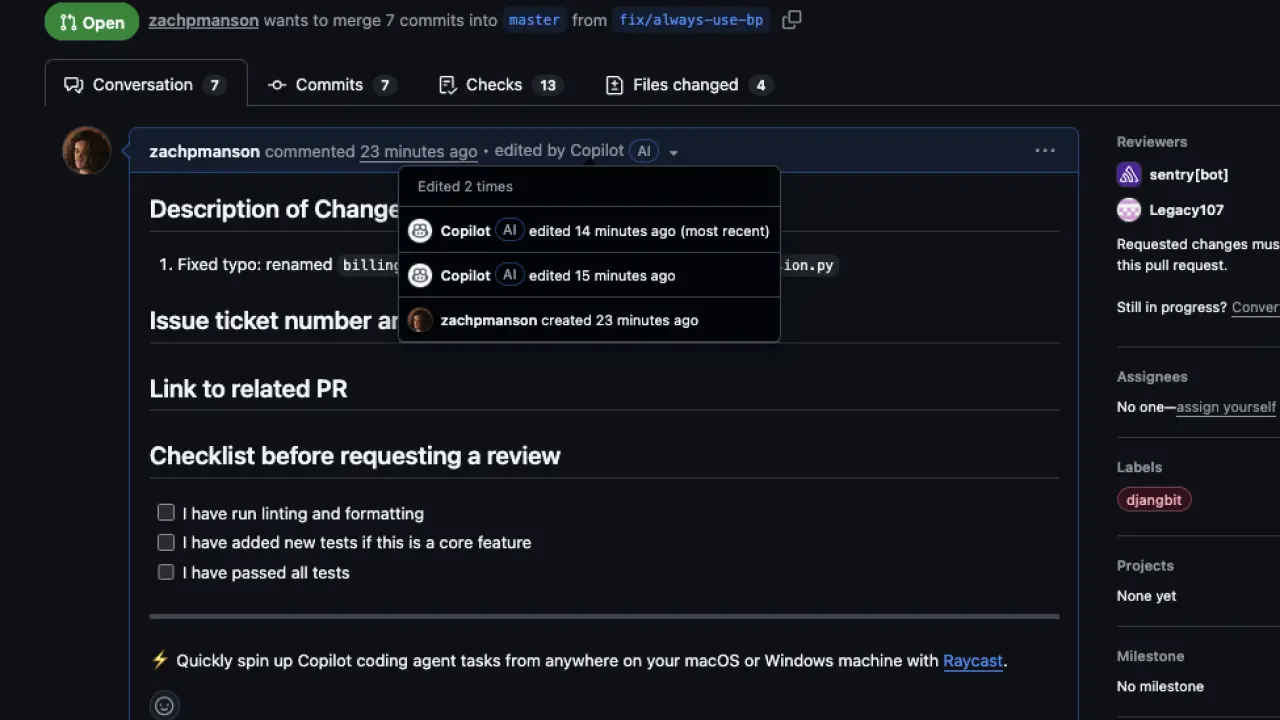
The incident itself was almost mundane in origin. A member of Manson's team used Copilot to fix a simple typo in a pull request. Copilot did fix the typo. But it also added this to the PR description: "⚡ Quickly spin up Copilot coding agent tasks from anywhere on your macOS or Windows machine with Raycast."
That is not a coding suggestion. That is an advertisement. And it was dressed up inside a developer tool that millions of engineers use to make consequential decisions about production software.

When Manson searched GitHub for the exact phrase injected into his PR, he found it replicated across more than 11,000 different pull requests in thousands of separate repositories. The same promotional text, the same hidden HTML comment (<!-- START COPILOT CODING AGENT TIPS -->), the same invisible injection mechanism — appearing in codebases from indie projects to enterprise repositories, and even in merge requests on GitLab, which Microsoft does not own.
This is not a bug. The hidden comment structure, the specificity of the promotional message, and the sheer scale of replication across 11,000 PRs all point to an intentional feature. Microsoft is using Copilot's write access to developer workflows as an advertising surface, and it is doing so inside the most trusted artifact in a software engineer's daily work: the pull request.
The broader context makes the move harder to dismiss as an aberration. The Sequoia Capital analysis from 2025 identified a roughly $400 billion gap between capital invested in AI infrastructure and actual revenue generated by AI products. The math is brutal. Your $20 monthly subscription does not come close to covering the inference costs — the GPU compute required every time you send a message or trigger an AI action. The industry has known this reckoning was coming. Now it has arrived, and it arrived inside your codebase.
Sam Altman has been ahead of this curve. OpenAI launched ads for its Free and Go tier users in January 2026, and within six weeks the ChatGPT ad business had already crossed $100 million in annualized revenue. Altman is now opening a self-serve ad platform for businesses next month and expanding the program to Canada, Australia, and New Zealand. The message from OpenAI is unambiguous: ads work, ads scale, and the AI platforms that control user attention will monetize it.
Microsoft is watching those numbers and applying the same logic to developer tooling. Copilot has write access to your pull requests. It has context about what you are building. It knows your dependencies, your team's workflow patterns, and — critically — the exact moment when a developer is most engaged with the tool. That is an advertiser's dream inventory. The only question was when someone would pull the trigger on using it.
The integration with Raycast is particularly telling. Raycast makes a Copilot extension that can create pull requests from natural language commands. Microsoft is essentially using its AI assistant to advertise products built on top of its own platform — a closed-loop promotional ecosystem that bypasses traditional ad formats entirely. There is no banner. There is no sponsored label. There is just text that looks like a helpful suggestion, inserted by a tool you trusted.

The developers discovering this in their repositories are reacting with a combination of disgust and dark recognition. The AI industry spent years promising that these tools were pure productivity gains, that the subscription model aligned incentives between user and platform, that the era of advertising-as-product had given way to something cleaner. Those claims now look difficult to defend.
Dario Amodei at Anthropic has been notably quieter on the monetization question, positioning Claude as the premium, safety-conscious alternative that enterprises can trust. But every time a competitor like Microsoft demonstrates what aggressive AI monetization actually looks like in practice, it creates both a warning and an opportunity. The question is whether the industry's trust deficit with developers — already strained by ChatGPT's surveillance architecture and the broader fingerprinting apparatus now being reverse-engineered in public — can survive a race to the bottom on ad injection.
For now, the answer from Microsoft is silence. No official statement, no disclosure about how many repositories were affected, no explanation of what the Raycast promotional relationship actually looks like from a financial standpoint.
The Rundown AI covered the OpenAI ad revenue milestone last week without noting what that milestone means for the tools developers actually build with. Superhuman AI flagged the GitHub story but framed it as a curiosity rather than a structural shift in how AI companies view their users. TLDR AI mentioned the PR injection but did not connect it to the broader inference economics driving every major lab toward advertising. What none of them said directly: this is not a bug in the system. This is the system working exactly as its economics demand.
AI-powered tools have write access to your codebase, your pull requests, your documentation, and your deployment pipelines. The question was never whether that access would be monetized. The question was only how long the industry would wait before doing it.
The answer, apparently, is not long at all.
Why The Rundown AI Missed This
The Rundown AI covered OpenAI's $100M ad milestone as a business story, but missed the structural connection: once the industry accepts ad injection as a revenue lever, it does not stay in consumer chat interfaces. It moves into developer tools, into enterprise workflows, into every surface where an AI has write access. Microsoft's Copilot PR injection is not a separate story from OpenAI's ad business — it is the same story, told from inside the developer's codebase. The significance is not the Raycast ad. It is that 11,000 pull requests proved the model works.
Deep Dive
For more context on how OpenAI is restructuring its business around advertising and enterprise revenue, read:
Found this useful? Share it.
Get posts like this in your inbox.
The Signal — AI & software intelligence. 4x daily. Free.
Subscribe free →
